

Table of Contents
- Is Premium Activewear Worth the Price? The Core Question
- The Benefits of Premium Activewear Beyond the Brand Name
- Expensive Activewear vs. Cheap Activewear: What You Actually Get
- Activewear Fabric Technology: Understanding What You're Paying For
- Cost-Per-Wear Analysis: Making the Math Work
- Care and Maintenance: Protecting Your Investment Long-Term
- Best Activewear Brands: Comparing Value Propositions
- When Premium Activewear Makes Sense, and When It Doesn't
Is Premium Activewear Worth the Price? A 2026 Guide
Last Updated: July 29, 2026
When deciding whether premium activewear is worth the price, you're asking if durability, performance technology, and longevity justify spending significantly more than fast-fashion alternatives. The answer depends on your training intensity, expected garment lifespan, and which features matter for your workouts. Below, we'll examine real differences between premium and budget activewear, show you how to calculate whether the investment makes sense, and reveal which brands deliver genuine value.
Is Premium Activewear Worth the Price? The Core Question
Premium activewear costs more upfront, but the real question is whether it delivers proportionally better performance and durability. A $120 pair of leggings from a luxury brand might use the same synthetic fiber composition as a $60 pair from a mid-tier competitor. What separates them is fit precision, proprietary fabric innovations, construction quality, and brand reputation. For high-intensity interval training or heavy lifting, premium activewear with superior compression and sweat-wicking becomes genuinely valuable. For casual gym sessions or yoga, the performance gap narrows significantly.
The cost-per-wear analysis is your best tool. A $150 pair of leggings worn 150 times costs $1 per wear. A $60 pair worn 40 times before pilling or losing elasticity costs $1.50 per wear. Premium activewear wins when durability extends the lifespan enough to offset higher initial cost.
The Benefits of Premium Activewear Beyond the Brand Name
Premium activewear delivers tangible performance advantages when engineered properly, directly impacting how your body performs during workouts and how long the garment survives intense training.
Durability and Longevity That Justifies Investment
Premium brands typically excel at holding shape, resisting pilling, maintaining elasticity, and surviving hundreds of wash cycles. Premium construction uses higher-grade synthetic fibers with tighter weaves that resist pilling. Budget activewear often pills noticeably after 10-15 washes, while premium gear typically resists visible pilling for 50+ washes.
Waistband rolling, where elastic loses tension during movement, is common in cheap activewear. Premium brands engineer waistbands with reinforced stitching and higher-quality elastic that maintains tension through intense workouts. Seam integrity matters significantly, cheap activewear uses basic straight stitching that fails under stress, while premium construction includes flat-lock or reinforced stitching that distributes tension across multiple threads.
Performance During High-Intensity Workouts
Premium activewear engineered for high-intensity activities provides measurable performance advantages during intense interval training, heavy lifting, or explosive cardio. Compression features improve blood circulation and reduce muscle fatigue during intense efforts. Quality premium brands specify their compression levels; budget brands rarely do.
Moisture-wicking performance separates premium from budget gear during high-intensity work. Premium fabrics pull sweat away from your skin efficiently, keeping you dry and preventing the uncomfortable clammy feeling that impairs performance. The ergonomic design of premium activewear matters during specific movements, for lifting, premium sports bras include structured support that prevents bounce and provides stability.
Moisture-Wicking and Breathability Technology
Breathability refers to how efficiently air flows through the fabric, preventing heat buildup. Moisture-wicking refers to how effectively the fabric pulls sweat away from your skin toward the outer surface for evaporation. Premium brands invest in proprietary fabric technologies designed specifically for moisture management, using engineered weaves and fiber blends that maximize surface area for evaporation while maintaining durability and stretch. Budget activewear often uses basic polyester blends that trap moisture against your skin.
Expensive Activewear vs. Cheap Activewear: What You Actually Get
The price difference between expensive and cheap activewear reflects real material and manufacturing differences.
Fabric Quality and Synthetic Fiber Composition
All modern activewear uses synthetic fibers, primarily nylon, polyester, and elastane. Quality differences lie in fiber grade, weave construction, and how these fibers are blended. Premium brands source higher-grade fibers with tighter specifications. The fiber blend matters significantly, premium activewear often uses 85% nylon / 15% elastane blends. Nylon provides superior durability, elasticity, and moisture-wicking compared to polyester. Budget activewear frequently uses polyester-heavy blends to reduce costs.
Elastane, also called spandex or Lycra, is the stretch component. Premium brands use higher-quality elastane that maintains elasticity through hundreds of wash cycles. Budget elastane degrades faster, causing that stretched-out feeling after a few months of regular wear.
Construction, Fit, and Compression Support
How activewear is constructed directly impacts how it performs and how long it lasts. Premium activewear uses flat-lock seams or reinforced stitching that distributes stress across multiple threads. Budget activewear uses single-thread straight stitching that fails under stress.
Fit precision separates premium from budget options. Premium brands invest in pattern grading, creating size-specific patterns that fit consistently across the size range. True compression requires specific fabric tension and engineered panel placement. Budget activewear might have a compression label, but without proper construction, it doesn't deliver actual compression benefits.
Pilling, Waistband Rolling, and Common Failure Points
Premium activewear using high-quality nylon resists pilling significantly longer than polyester-heavy budget alternatives. Under identical wear conditions, premium nylon leggings might show minor pilling after 40+ wears, while budget polyester alternatives pill noticeably after 10-15 wears.
Loss of elasticity is another failure point. Premium activewear using higher-quality elastane maintains stretch for 2-3 years of regular wear. Budget elastane starts losing elasticity noticeably after 6-12 months.
Activewear Fabric Technology: Understanding What You're Paying For
Premium activewear brands invest heavily in proprietary fabric technologies. Understanding what these technologies actually do helps you evaluate whether the premium price delivers real value.
Nylon vs. Polyester vs. Elastane: Technical Breakdown
Nylon is the premium choice for activewear. It's more durable than polyester, offers superior elasticity, provides excellent moisture-wicking, and resists pilling effectively. High-nylon blends (80%+ nylon) are typical in premium activewear.
Polyester is cheaper to produce but inferior to nylon. Polyester pills more easily, provides less moisture-wicking, and doesn't recover from stretching as effectively. Budget activewear often uses polyester-heavy blends to reduce costs.
Elastane (spandex/Lycra) is the stretch component in all activewear, typically comprising 10-20% of the blend. Quality elastane maintains elasticity through hundreds of wash cycles. The ideal premium blend for high-intensity activewear is approximately 85% nylon / 15% elastane.
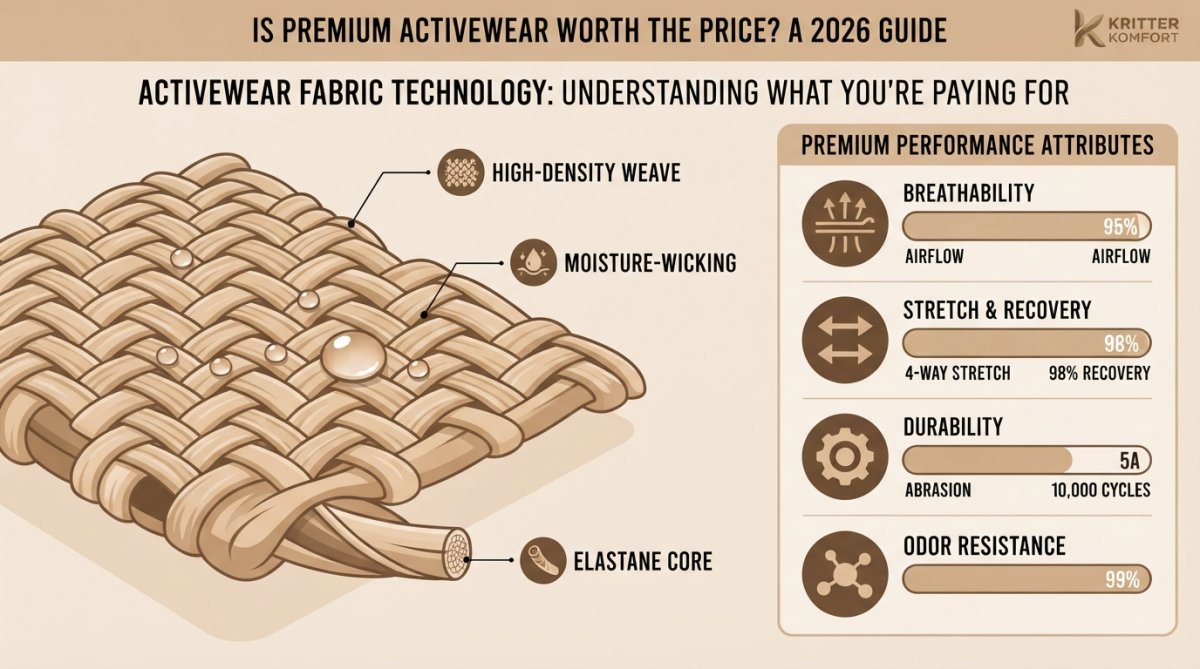
Four-Way Stretch and Proprietary Fabric Innovations
Four-way stretch means the fabric stretches in all directions: horizontally, vertically, and diagonally. Not all four-way stretch is equal. Budget brands might claim four-way stretch but deliver inferior stretch recovery. Premium brands engineer four-way stretch to be consistent and durable.
Proprietary fabric innovations differentiate premium brands through engineered weaves that maximize breathability, moisture-management systems designed for sweat evaporation, anti-microbial treatments that reduce odor, temperature-regulating technologies, or UV protection for outdoor training. Budget brands skip this entirely, using standard fabric construction.
Kritter Komfort's approach to fabric technology focuses on breathable, stretch-friendly materials that perform reliably during intense workouts. The emphasis on durability and machine-wash friendliness reflects a commitment to practical performance over trendy marketing claims.
Cost-Per-Wear Analysis: Making the Math Work
The most objective way to evaluate whether premium activewear is worth the price is calculating cost-per-wear. Divide the purchase price by the number of times you'll wear the item before it becomes unwearable.
For someone training 4+ times weekly with intense workouts, premium activewear typically becomes cost-effective:
- Premium leggings: $120 purchase price, worn 3x weekly for 2.5 years = 390 wears = $0.31 per wear
- Budget leggings: $50 purchase price, worn 3x weekly for 8 months before pilling/stretching = 96 wears = $0.52 per wear
Over 2.5 years, you'd need to buy four budget alternatives (costing $200 total) versus one premium pair (costing $120). Premium wins decisively.
However, if you train only 1-2 times weekly, the math changes:
- Premium leggings: $120 purchase price, worn 1.5x weekly for 3 years = 234 wears = $0.51 per wear
- Budget leggings: $50 purchase price, worn 1.5x weekly for 1.5 years = 117 wears = $0.43 per wear
At lower usage frequency, budget activewear might be more cost-effective.
| Usage Level | Weekly Wears | Best Option | Cost-Per-Wear Advantage |
|---|---|---|---|
| Casual (1-2x/week) | 52-104/year | Budget or mid-tier | Budget slightly cheaper |
| Moderate (3-4x/week) | 156-208/year | Mid-tier to premium | Premium breaks even |
| Intense (5+x/week) | 260+/year | Premium | Premium significantly cheaper |
The break-even point typically occurs around 150-200 total wears. If you'll wear an item more than 200 times before it becomes unwearable, premium activewear usually delivers better cost-per-wear.
Care and Maintenance: Protecting Your Investment Long-Term
How you care for activewear dramatically impacts how long it lasts. Premium activewear's durability advantage disappears if you don't maintain it properly.
Machine-Wash Durability and Fabric Care
Premium activewear is designed to withstand machine washing, but specific practices extend longevity significantly. Turn items inside-out before washing to reduce friction on the outer surface. Use cold water and gentle cycle settings; hot water weakens elastane and accelerates degradation. Avoid fabric softeners and bleach, which damage synthetic fibers and reduce moisture-wicking performance.
Air drying preserves elastane and extends garment lifespan far better than machine drying. Washing frequency affects durability too; activewear doesn't need washing after every wear if you're not visibly sweaty.
Kritter Komfort's machine-wash friendly design means you can use standard washing practices without worrying about delicate handling. This practicality, activewear that survives normal washing routines, is a key value proposition for customers prioritizing durability.
Resale Value and the Secondhand Market
Premium activewear often retains resale value because durability means used items still have significant lifespan remaining. Well-maintained premium pieces sell for 40-60% of original retail price on platforms like Poshmark, Depop, and Vestiaire Collective. Budget activewear rarely retains resale value; used budget pieces typically sell for 10-20% of original price.
A $120 premium pair worn 200 times and sold for $60 costs only $0.30 per wear, further tipping the cost-per-wear calculation in favor of premium activewear for high-volume users.
Best Activewear Brands: Comparing Value Propositions
Different brands approach the premium-versus-budget spectrum differently. Understanding what separates them helps you make informed decisions aligned with your priorities.
Luxury Brands vs. Mid-Tier Options
Luxury activewear brands (Lululemon, On, Alo Yoga) command premium prices partly through superior engineering and partly through brand prestige. Mid-tier brands (Athleta, Outdoor Voices, Girlfriend Collective) offer strong performance and durability at lower price points.
Luxury brands typically invest heavily in proprietary fabric technology and rigorous quality control. However, luxury brands also charge for brand prestige. A $128 Lululemon sports bra and a $65 Athleta sports bra might use similar fabric compositions and deliver comparable performance. Mid-tier brands offer a practical sweet spot, investing in quality fabrics and construction without the luxury brand markup.
Kritter Komfort positions itself as a performance-focused brand that doesn't demand luxury pricing. The emphasis on durability, breathability, and practical design appeals to customers prioritizing genuine performance over brand status.
Ethical Manufacturing and Brand Reputation
Where activewear is manufactured and under what labor conditions affects both brand reputation and product quality. Brands manufacturing in developed countries typically maintain higher labor standards and stricter quality control. Brand transparency about manufacturing practices signals commitment to ethical standards. Customer reviews and reputation provide insight into whether brands deliver on promises.
When Premium Activewear Makes Sense, and When It Doesn't
Premium activewear delivers genuine value in specific situations but represents unnecessary spending in others.
Premium activewear makes sense when you train intensely 4+ times weekly, perform high-impact activities like HIIT or heavy lifting, prioritize performance features like compression and moisture-wicking, plan to wear items for 2+ years (200+ total wears), like updating your wardrobe regularly and value resale options, or need specific performance features like true four-way stretch or proprietary moisture-management technology.
Budget activewear makes sense when you train casually 1-2 times weekly, are trying new activities and want to experiment without major investment, have frequent style changes and prefer variety over longevity, have a limited activewear budget, or prioritize having many different styles and colors over keeping items for years.
Mid-tier activewear represents a practical compromise for most people. Mid-tier brands offer significantly better durability and performance than budget alternatives while costing 30-40% less than luxury brands. For someone training 3-4 times weekly with moderate intensity, mid-tier activewear typically delivers the best value.
Whether premium activewear is worth the price depends on your training frequency, intensity, and how long you plan to wear each item. For high-volume users training intensely 4+ times weekly, premium activewear's superior durability and performance features deliver genuine value. For casual gym-goers or those training 1-2 times weekly, budget or mid-tier options often provide better value.
The key is calculating your realistic cost-per-wear and understanding what specific features matter for your training style. If you'll wear an item 200+ times before it becomes unwearable, premium activewear's durability typically justifies the higher price.
Kritter Komfort delivers premium performance without luxury brand pricing. The focus on breathable fabrics, durable construction, and practical machine-wash care addresses the real priorities of serious athletes: reliable performance and longevity, not trendy marketing. For anyone prioritizing genuine durability and performance over brand status, Kritter Komfort's value proposition aligns with what actually matters for training success. Shop All and discover activewear engineered for intense training and everyday versatility.
Frequently Asked Questions
Is premium activewear worth the price if I only work out a few times a week?
It depends on your cost-per-wear tolerance and durability expectations. If you wear pieces 50+ times over 12 months, premium activewear's superior durability and moisture-wicking technology often justify the higher upfront cost. Cheaper alternatives may pill, lose elasticity, or develop waistband rolling after frequent washing. Calculate cost-per-wear by dividing total price by estimated wears, premium pieces often cost less per wear over time despite higher initial prices.
What makes expensive activewear brands different from budget options in terms of fabric technology?
Premium activewear typically uses proprietary blends of nylon, polyester, and elastane optimized for specific performance needs. High-end brands invest in four-way stretch fabrics, advanced sweat-wicking systems, and quality control that reduces pilling and waistband rolling. Budget activewear often uses basic synthetic fibers without specialized moisture-wicking or compression features. The difference in breathability, durability, and comfort during high-intensity workouts is often noticeable after the first few uses and compounds over months of training.
How do I know if a premium activewear brand has ethical manufacturing and good quality control?
Research brand reputation through customer reviews focusing on durability claims and long-term wear reports. Check if the brand publishes information about manufacturing locations and labor practices. Read specific feedback about pilling, shrinkage, and fit consistency. Reputable premium brands often highlight quality control processes and offer clear return policies, indicating confidence in their products. Look for certifications or transparency statements about ethical labor standards, which distinguish genuine luxury activewear from brands simply using brand markup without backing it up.
Can premium activewear actually improve my workout performance, or is it just marketing?
Quality activewear can measurably improve comfort during high-intensity interval training by reducing sweat buildup, preventing chafing, and providing proper compression and support. Moisture-wicking fabrics keep you cooler and drier, which reduces distraction during workouts. Proper ergonomic design and four-way stretch prevent restriction during lifting and cardio. However, the performance gain is in comfort and confidence, not athletic ability itself. Premium activewear won't make you stronger, but it removes friction, literally and mentally, allowing you to focus entirely on your training.
This article was written using GrandRanker