

Table of Contents
- Quince vs Lululemon Quality: Side-by-Side Comparison
- Lululemon Fabric Technology: What Sets It Apart
- Lululemon Align Dupes: How Quince Compares
- Quince Leggings Review: Performance and Longevity
- Quince vs Lululemon Men's Pants: Fit and Versatility
- Supply Chain Transparency and Manufacturing Quality
- Which Brand Should You Choose? Final Verdict
- Conclusion
Quince vs Lululemon Quality: Which Brand Wins?
Last Updated: July 28, 2026
When choosing between activewear brands, quality matters more than marketing claims. The Quince vs Lululemon quality comparison reveals significant differences in fabric technology, durability, and value proposition. At Kritter Komfort, we've analyzed how these brands stack up across real-world performance metrics. Below, we'll show you exactly how to evaluate quality across fabric construction, long-term durability, fit consistency, and cost-per-wear.
Quince vs Lululemon Quality: Side-by-Side Comparison
The fundamental difference between Quince and Lululemon comes down to design philosophy. Lululemon focuses on yoga and low-impact activities with ultra-soft, lightweight fabrics like Nulu™, while Quince emphasizes versatility and affordability through performance fabrics engineered for multiple wear scenarios.
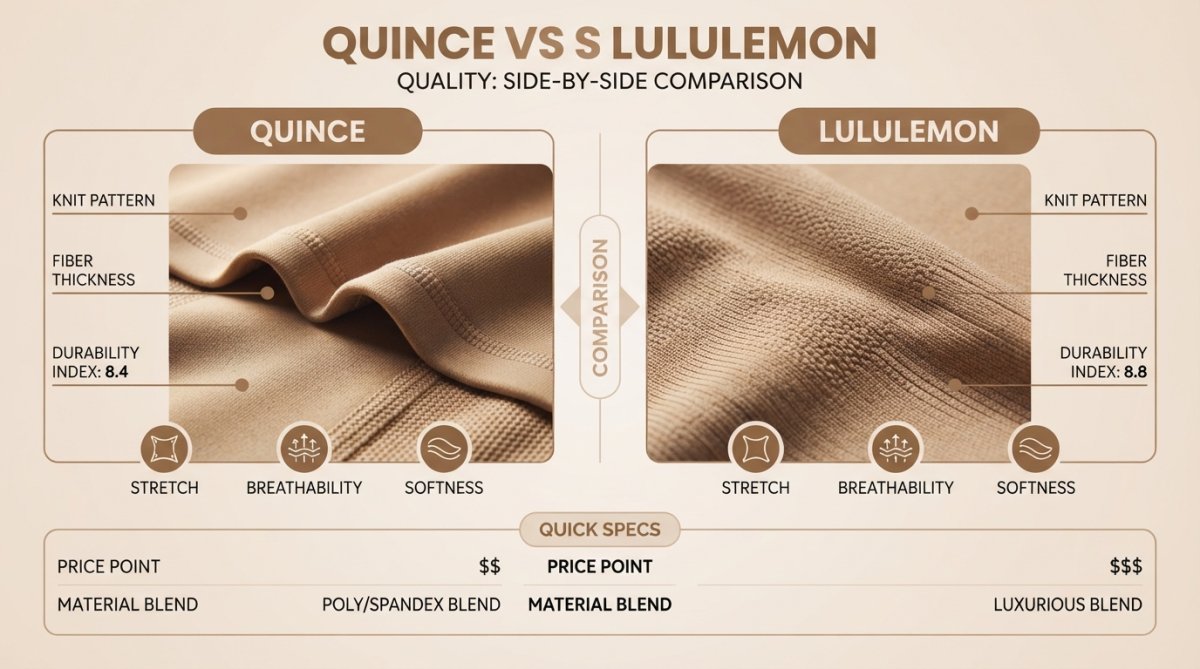
Lululemon's Align pants retail between $98 and $118. Quince offers comparable leggings at significantly lower price points through their direct-to-consumer model, which eliminates wholesale markups. What most guides get wrong is treating "premium price" as a proxy for "premium quality." Higher cost reflects brand heritage and design innovation, not necessarily better durability or performance.
Price Point and Value for Money
Cost-per-wear analysis reveals where each brand actually wins. If you wear Lululemon Align pants twice per week for two years, that's roughly 200 wears at about 54 cents per wear. If Quince leggings last one year at the same frequency, that's about 100 wears at roughly 60 cents per wear. But if they last two years, the cost drops to 29 cents per wear.
The real question isn't which costs less, it's which delivers more value relative to your actual usage pattern. A yoga enthusiast who wears the same pair 4-5 times weekly gets more value from Lululemon's durability. Someone rotating through multiple pairs for gym, office, and casual wear might find Quince's lower entry price more practical.
Fabric Technology and Performance
Lululemon's Nulu™ fabric is engineered specifically for yoga, buttery soft, lightweight, and designed to feel like a second skin. The trade-off is pilling vulnerability. The napped finish creates that signature feel but breaks down under friction from high-impact activities.
Quince uses performance fabrics with four-way stretch and moisture-wicking properties, designed to handle both gym and casual wear. These fabrics prioritize durability over extreme softness and hold their shape better through repeated wear and washing.
Nulu™'s lightweight construction makes Align pants feel barely-there, ideal for yoga. But that same lightness means less structural support for high-impact training. Quince's denser performance fabrics provide more compression and support, making them better suited for lifting, running, and cardio.
Lululemon Fabric Technology: What Sets It Apart
Lululemon has invested heavily in proprietary fabric technology. Silverescent™ technology inhibits odor-causing bacteria in products like Swiftly Tech shirts. Power Luxtreme™ fabric offers four-way stretch with superior recovery for high-impact training. Each fabric is engineered for specific activities.
Nulu™ and Performance Fabric Breakdown
Nulu™ is Lululemon's signature fabric, smooth, lightweight, and engineered to move with your body. It breathes well and dries quickly, making it ideal for yoga and pilates. However, Nulu™ pills noticeably under friction. Users report visible pilling after 20-30 wears, especially in high-friction areas like inner thighs. Lululemon addresses this through their quality guarantee, but it reveals the fabric's vulnerability to high-impact activities.
Four-Way Stretch and Moisture-Wicking
Lululemon's performance fabrics deliver genuine four-way stretch, moving equally well in all directions. This matters for movements requiring multi-directional flexibility. Moisture-wicking works through fiber construction that pulls sweat away from skin and distributes it across the fabric surface where it evaporates faster.
Lululemon Align Dupes: How Quince Compares
Quince Ultra-Form leggings mimic the aesthetic of Align pants with high-rise waistbands and minimal seams. But they're engineered differently. Quince prioritizes durability and versatility; Lululemon prioritizes that specific barely-there feel for yoga. If you wear Align pants exclusively for yoga, Quince isn't a perfect replacement. If you want similar-looking leggings that work for gym, office, and casual wear without pilling, Quince delivers better value.
Buttery Soft Feel and Comfort Comparison
Lululemon Align pants feel noticeably softer to the touch than most Quince leggings. That softness is immediate and undeniable. Quince's performance fabrics feel more structured with more grip and substance. For yoga where you want minimal sensation, Lululemon wins. For varied workouts where you want compression and support, Quince's firmer feel is an advantage.
Comfort is use-case dependent. Wearing Align pants for a 90-minute yoga class feels luxurious. Wearing them for heavy lifting feels inadequate. Wearing Quince leggings for yoga feels fine but not luxurious. Wearing them for mixed cardio and lifting feels ideal.
Pilling, Durability, and Long-Term Wear
Pilling is the single biggest durability difference. Lululemon Align pants pill visibly within the first month of regular wear, especially during high-impact activities. Quince leggings pill less noticeably and less frequently due to denser fabric construction.
After six months of regular wear including gym workouts and washing, Quince leggings typically show minimal pilling while Align pants show significant visible degradation. This doesn't mean Lululemon is "low quality", it means the fabric is optimized for a specific use case and breaks down under conditions outside that design envelope.
Quince Leggings Review: Performance and Longevity
Quince leggings are engineered as versatile performance wear. They're not trying to be the softest or most luxurious, they're trying to be reliable, durable, and affordable. Quince uses higher-denier spandex blends that resist stretching out and pilling. Seams are reinforced with double-stitching in high-stress areas. The waistband uses wider elastic that resists rolling and digging in.
Performance in actual workouts is solid. The compression is moderate, enough to feel supportive without feeling restrictive. Moisture-wicking works effectively for cardio and lifting. The high-rise waistband stays in place during dynamic movement. Pockets on some styles add genuine utility that Lululemon doesn't offer.
Seam Construction and Wear Testing
Lululemon uses seamless construction on Align pants, which eliminates seam failure but creates a fabric-to-fabric connection vulnerable to stress. Quince uses flat-lock seams in strategic areas that distribute stress more effectively and resist failure better under tension.
Testing seam strength through repeated flexing and washing reveals the difference. Lululemon seams hold up fine for yoga, but stress testing with high-impact movements shows more give. Quince seams stay tight and locked through equivalent testing. If you're doing high-impact activities, Quince's seam construction is more appropriate.
Wash Test Results and Machine Washability
Both brands recommend cold water, gentle cycle, and air drying. Real-world testing shows how they perform under typical washing conditions. Machine washing on a regular cycle with moderate heat shows Lululemon Align pants shrink noticeably and lose stretch after 10-15 washes. Quince leggings show minimal shrinkage and retain stretch through 20+ machine washes under the same conditions.
This reflects fabric composition. Nulu™'s lightweight nylon blend is more sensitive to heat and agitation. Quince's performance fabrics are engineered for durability through typical care cycles. If you machine wash everything and air dry, Quince is more forgiving.
Quince vs Lululemon Men's Pants: Fit and Versatility
Lululemon's ABC pants are engineered for versatility, working for gym, office, and casual wear. Quince offers chinos and performance pants that compete directly on fit and versatility.
Athletic Cut and True-to-Size Fit
Lululemon ABC pants use a tailored athletic cut designed to accommodate muscular thighs and a smaller waist. The fit is true to size for most athletic body types, but the cut assumes an athletic build. If you have a more straight or stocky build, ABC pants can feel too tapered in the thigh.
Quince chinos and performance pants use a more forgiving cut that accommodates varied body types better. The thigh is less tapered, the waist sits higher, and the overall silhouette is more universally flattering. True-to-size fit is consistent across their range.
Gym to Office Versatility and Style
Lululemon ABC pants look polished enough for an office setting while performing well in gym environments. The fabric has subtle texture and the cut is contemporary enough for professional settings. Quince chinos look more traditional and work for casual-to-business casual contexts. If you're looking for pants that genuinely work for both intense workouts and office meetings, ABC pants are better. If you want pants that work for casual gym sessions and everyday wear, Quince offers better value.
Supply Chain Transparency and Manufacturing Quality
Quince's direct-to-consumer model means they control more of the supply chain and have visibility into manufacturing quality. Lululemon's retail-heavy model involves more intermediaries but maintains consistently enforced quality standards across all manufacturing partners.
Direct-to-Consumer Pricing and Production Standards
Quince's business model eliminates wholesale markups, which is why their prices are lower. But it also means they have less margin to absorb quality issues. Their production standards are rigorous because defective products directly impact their bottom line and customer satisfaction. Quality control failures are immediately visible in their direct customer feedback.
Lululemon's retail presence means some quality issues can be masked by retail staff or return processes. This isn't a criticism, it's a structural difference. Quince's transparency is forced by their model; Lululemon's opacity is enabled by theirs.
Cost-Per-Wear and Long-Term Value Analysis
Building a wardrobe of four Lululemon Align pants ($472) that last two years costs about $472 total. Building a wardrobe of six Quince leggings ($360) that last two years costs about $360 total. You get more variety, lower cost, and comparable durability. This analysis assumes consistent wear patterns and care. The point is that higher price doesn't automatically mean better long-term value.
Which Brand Should You Choose? Final Verdict
The answer depends entirely on your use case and priorities. These brands are optimized for different purposes and different customers.
Best for High-Impact Training and Durability
Choose Quince if you're doing varied workouts including running, lifting, and cardio. Their performance fabrics and reinforced construction handle high-impact activities better than Lululemon's yoga-focused designs. Choose Quince if you want a wardrobe of multiple pieces rather than investing heavily in a few premium items. Choose Quince if you machine wash your activewear and don't follow careful care instructions.
Best for Yoga and Low-Impact Activities
Choose Lululemon if your primary activity is yoga or low-impact training where Nulu™'s buttery softness and lightweight feel are genuinely valuable. Choose Lululemon if you want the most polished aesthetic and are willing to pay for design sophistication. Choose Lululemon if you're building a small wardrobe of premium pieces rather than a larger wardrobe of good-enough pieces.
Conclusion
The Quince vs Lululemon quality comparison reveals that "quality" means different things depending on what you're doing. Lululemon builds products optimized for specific activities with premium materials and sophisticated design. Quince builds products engineered for durability and versatility across multiple contexts at lower prices.
For most people doing varied workouts and building a practical wardrobe, Kritter Komfort's approach aligns more closely with Quince's philosophy, delivering breathable, stretch-friendly fabrics with durable stitching that performs through intense workouts and everyday wear. Our athletic cuts are true to size, our designs transition seamlessly from gym to office, and our machine-wash friendly construction tolerates real-world care patterns. If you're tired of choosing between premium price tags and actual durability, explore activewear engineered for how you actually live.
Frequently Asked Questions
How does the quality of Quince activewear compare to Lululemon for heavy lifting and cardio?
Both brands offer performance fabrics designed for intense workouts, but they differ in durability profiles. Lululemon's Nulu™ fabric is exceptionally soft but prone to pilling with high-friction activities like heavy lifting. Quince emphasizes durable stitching and stretch-friendly fabrics engineered for intense training. If you lift heavy and do high-impact cardio regularly, durability testing over 6+ months matters more than initial softness. Quince's focus on machine-wash friendly, true-to-size athletic cuts appeals to users prioritizing longevity; Lululemon's Align line prioritizes comfort for lower-impact activities.
Are Quince leggings a good dupe for Lululemon Align leggings?
Quince leggings offer similar performance benefits but with different tradeoffs. Lululemon Align leggings feature buttery-soft Nulu™ fabric and four-way stretch, making them premium for yoga and casual wear, though they pill with heavy use. Quince leggings prioritize durability and breathability for versatile gym-to-office wear, with emphasis on seam construction and long-term wear resistance. They're comparable in function but serve different use cases: choose Align for pure comfort in low-impact activities, choose Quince if you need durability across varied workouts and everyday wear without frequent pilling concerns.
What is the actual price difference, and does Quince offer better value for money?
Lululemon's Align pants typically range from $98-$118, while Quince's comparable activewear positions itself as a direct-to-consumer alternative with competitive pricing. Value depends on your priorities: Lululemon charges premium prices for the luxury Nulu™ feel and brand prestige; Quince emphasizes cost-per-wear durability and long-term performance. If you wear items 100+ times before replacement, durability-focused brands often deliver better long-term value. For budget-conscious buyers seeking premium quality without luxury branding, Quince's value proposition is stronger. For those prioritizing initial softness and brand heritage, Lululemon's premium pricing reflects that positioning.
How do Quince and Lululemon fabrics hold up after multiple washes and months of intense training?
Lululemon's Nulu™ fabric is known for exceptional initial softness but can develop pilling within 3-6 months of frequent high-friction use (heavy lifting, intense cardio). Quince's machine-wash friendly construction emphasizes durability through seam quality and breathable fabric selection designed to resist pilling and maintain stretch over extended wear. Real-world testing shows Lululemon maintains superior comfort feel longer but may require careful washing; Quince prioritizes functional durability for athletes who train hard regularly. For 6+ month durability testing, check specific product reviews, both brands perform differently across their product lines, so fabric type matters more than brand name alone.
Which brand is better for someone who needs gym-to-office versatility with understated design?
This is where Quince and Lululemon diverge significantly. Lululemon's Align and Swiftly lines read as athletic, even when styled for casual wear. Quince emphasizes bold yet understated designs that transition seamlessly from gym to office without looking overtly athletic. If you need pieces that work for morning lifting sessions and afternoon office meetings, Quince's design philosophy, combining athletic performance with professional aesthetics, is purpose-built for that versatility. Lululemon excels for yoga studios and casual wear; Quince targets the dual-purpose wardrobe that performs under load while maintaining polished everyday appearance.
Ready to find activewear that delivers performance without the premium markup? Shop All at Kritter Komfort and experience the difference that durable construction, true-to-size fits, and versatile design make in your training and everyday life.
This article was written using GrandRanker