

Table of Contents
- How Long Do Golf Pants Last for Women? The Short Answer
- Signs of Wear in Athletic Pants: When to Repair, Retire, or Keep Playing
- How to Wash Performance Fabrics Properly (and What Shortens Their Life)
- Material-Specific Longevity: Which Golf Pants Last Longest for Women
- How Often Should You Replace Golf Pants? A Realistic Timeline by Play Frequency
- Repair and Restoration Guide: How to Extend the Life of Golf Pants
- Sustainability and Recycling: What to Do With Retired Golf Pants
- Conclusion: Building a Rotation That Lasts
- Frequently Asked Questions
Last Updated: September 14, 2026
How Long Do Golf Pants Last for Women? The Short Answer
Most women's golf pants last between one and three years of regular play, depending on fabric quality and how you care for them (pubmed.ncbi.nlm.nih.gov). Kritter Komfort builds performance apparel with breathable, stretch-friendly fabrics and durable stitching, so the answer often comes down to care rather than construction. This guide covers how long do golf pants last for women, the signs that tell you when a pair is done, and the washing habits that quietly shorten their life. Below, we'll show you exactly how to spot wear, wash performance fabrics properly, and build a rotation that keeps your best pairs in play for years.
The single biggest factor isn't price. It's how you wash them.
Signs of Wear in Athletic Pants: When to Repair, Retire, or Keep Playing
Signs of wear in athletic pants fall into two categories: fabric-level clues and fit-and-function clues. Fabric clues show up first, usually around the seat, inner thighs, and knees. Fit clues appear later, but they matter more for your swing.
Fabric-Level Clues: Pilling, Fading, and Loss of Shape
Pilling is the first warning sign. Small fiber balls form where friction is highest, and once pilling starts, fabric durability is already declining. Fading follows, especially in darker colors exposed to UV protection demands on the course. Loss of shape is the third clue: stretch panels that no longer snap back mean the spandex blend has fatigued.
Check these three points after every few rounds:
- Inner thighs and seat for pilling
- Knee area for thinning or shine
- Waistband and seams for stretched stitching
Fit and Function Clues: Waistband Roll, Sagging Knees, and Restricted Swing
A waistband that rolls or digs in signals elastic breakdown. Sagging knees mean the fabric has lost shape retention, and restricted swing mobility points to stretched-out four-way stretch panels. Once a pair restricts your swing, it's a playing problem, not a cosmetic one.
How to Wash Performance Fabrics Properly (and What Shortens Their Life)
Performance golf pants fail from the inside out, and the laundry is usually where it happens. The three rules, cold water, gentle detergent, air dry, are correct, but understanding why each rule exists is what separates a pair that lasts three seasons from one that sags by August.
The mechanisms that shorten a pant's life
- Heat and spandex. Elastane fibers are thermoplastic. Repeated exposure to hot water (above roughly 105°F) and a hot dryer breaks the polymer bonds that give the fiber its snap-back. Once those bonds fail, the fabric stays stretched, that's the sagging knee and rolled waistband you notice later.
- Fabric softener and dryer sheets. These coat synthetic fibers with a waxy film (pubmed.ncbi.nlm.nih.gov). On a moisture-wicking fabric, that film blocks the capillary action that pulls sweat to the surface, so the pant stops breathing even though the fabric itself is intact. The pant isn't worn out, it's clogged.
- Mechanical abrasion. Tumbling in a dryer throws the pant against the drum and other garments. That friction accelerates pilling at the inner thigh and seat, the same zones that already take the most wear from your swing and stance.
- Detergent residue. Overdosing detergent leaves residue in the weave that stiffens the fabric and dulls color. More detergent does not mean cleaner pants.
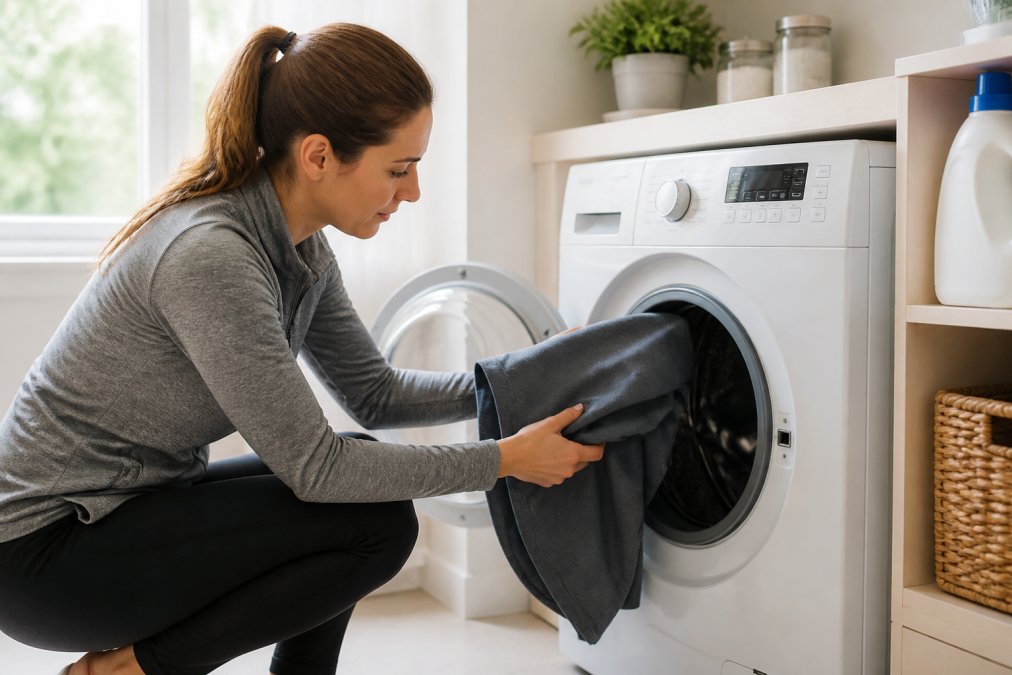
Step-by-step: the routine that protects stretch and wicking
- Turn pants inside out. This puts the surface abrasion on the inside of the garment instead of the visible face, and it lets detergent reach the skin-side oils that build up.
- Wash cold, ideally on a cold/cold cycle. If your machine has a temperature setting, aim for the coolest option; anything approaching warm starts working against the spandex.
- Use a mild, softener-free detergent. A small amount is enough. Skip pods that include softener.
- Skip fabric softener and dryer sheets entirely. If you want static control, a wool dryer ball on low heat is a better option than a sheet.
- Air dry flat or hang, away from direct sun. Direct UV over many cycles fades darker colors and weakens the fabric surface.
- Store folded, not on a wire hanger. A hanger concentrates the pant's weight on the waistband and stretches it out over time.
Total time: about 10 minutes of handling, plus drying time.
Expected result: shape retention, stretch recovery, and moisture-wicking performance hold up noticeably longer than with machine drying.
A note on frequency
You don't need to wash golf pants after every round. If they aren't visibly soiled or heavily sweated through, airing them out and spot-cleaning the inner thigh and seat is often enough. Washing less frequently, but washing correctly when you do, is one of the simplest ways to extend usable life.
Material-Specific Longevity: Which Golf Pants Last Longest for Women
Fabric composition is the single biggest predictor of how long a pair of women's golf pants will last, and the differences come down to fiber mechanics rather than marketing labels. Two pants can both say "polyester-spandex" and still differ by a full season of usable life depending on the spandex percentage, the fabric weight, and how tightly the yarn is woven.
What actually determines lifespan at the fiber level
- Spandex (elastane) percentage. Most performance golf pants use 8-20% spandex blended into polyester or nylon (pubmed.ncbi.nlm.nih.gov). Higher spandex means more four-way stretch and a better swing, but spandex is the first fiber to fatigue, it loses recovery with every heat cycle. A 12% spandex blend that is washed cold can outlast a 20% blend that is tumble-dried.
- Denier and fabric weight. Denier measures yarn thickness. Higher-denier polyester (think 150D and up) resists abrasion at the inner thigh and seat far better than lightweight 50-75D fabrics, which is why budget pants often thin out first at friction points.
- Weave structure. A tight plain or twill weave sheds pilling better than a loose knit or brushed interior. Brushed-back fabrics feel soft but trap lint and pill faster.
- Nylon vs. polyester. Nylon-spandex blends are typically more abrasion-resistant and slightly more breathable, but they cost more and can be more prone to snagging on cart seats and bag straps. Polyester-spandex is the more common workhorse and holds color better under UV exposure.
How the main fabric types compare
| Fabric Type | Typical Lifespan (regular play) | Strengths | Weaknesses |
|---|---|---|---|
| Polyester-spandex (12-20% spandex, mid-weight) | Longest, often 2-3 seasons in a rotation | Four-way stretch, fast-drying, colorfast | Low-quality versions pill at friction points |
| Nylon-spandex | Long, comparable to good polyester blends | High abrasion resistance, breathable | Pricier, can snag |
| Cotton or cotton-rich blend | Short, often under a season with frequent play | Soft hand feel, breathable | Sags, wrinkles, slow to dry, no moisture-wicking |
| Cheap synthetic (low spandex, low denier) | Shortest, sometimes a single season | Low upfront cost | Pills fast, loses shape, shiny at knees |
The trade-off most guides skip
There is a real tension between stretch and longevity. The stretchier the pant, the more spandex it contains, and the faster that spandex will fatigue under heat and repeated washing. If you play multiple rounds a week, a mid-stretch (roughly 12-15% spandex) mid-weight polyester blend usually outlasts a high-stretch fashion pair. If your priority is maximum freedom of movement for a few rounds a month, the higher-stretch fabric is a reasonable trade.
A common pattern among frequent players is to keep one high-stretch pair for rounds where feel matters most and a mid-weight, lower-stretch pair for practice and range sessions, where abrasion from repeated swings is highest.
If longevity is your priority, look for a mid-weight polyester-spandex blend with a tight weave and a spandex content in the low-to-mid teens. Kritter Komfort's athletic cut and durable stitching are built around exactly this kind of fabric, so the pants move well and hold their shape over seasons of wear.
How Often Should You Replace Golf Pants? A Realistic Timeline by Play Frequency
Replacement timing depends on how often you play and how many pairs you rotate. A single pair worn for every round will wear out far faster than the same pant shared across a rotation of three or four.
| Play Frequency | Pairs in Rotation | Realistic Replacement Window |
|---|---|---|
| Weekly rounds | 1 pair | Roughly 1 season |
| Weekly rounds | 3-4 pairs | 2-3 seasons |
| Twice monthly | 2 pairs | 2-3 years |
| Occasional play | 2 pairs | 3+ years |
The pattern is simple: fewer pairs and more regular play shorten the timeline. Rotating pairs gives each one time to recover shape between wears.
Repair and Restoration Guide: How to Extend the Life of Golf Pants
Most guides skip repairs entirely, but a few fixes can add real time to a pair. Loose stitching at a hem or pocket can be re-sewn before it becomes a tear. A stretched waistband can sometimes be helped by a gentle warm rinse and flat drying, though it won't fully restore elastic that has already failed. Stubborn pilling can be shaved off with a fabric pill remover, which restores appearance even if it can't restore fiber strength.
What most guides miss is that small repairs done early prevent the bigger failures that force replacement. A two-minute stitch on a seam beats buying a new pair.
Sustainability and Recycling: What to Do With Retired Golf Pants
Retired golf pants don't have to go in the trash. Synthetic performance fabrics are recyclable through textile recycling programs, and many brands and retailers now run take-back schemes. If the pant is still wearable, donating it keeps usable fabric in circulation. For pairs that are truly done, look for textile recycling drop-off points rather than curbside bins, since most municipal programs don't accept stretch fabrics.
Choosing durable pants in the first place is the most effective sustainability move. The longer a pair lasts, the less often you replace it, and the smaller your textile footprint.
Conclusion: Building a Rotation That Lasts
The real challenge isn't finding pants that survive one season. It's building a rotation that keeps every pair performing for years, which means washing cold, air drying, and retiring a pair the moment it restricts your swing. Kritter Komfort offers breathable, stretch-friendly fabrics, an athletic cut that's true to size, and durable stitching built for hard training. Shop All and build a rotation that moves from the gym to the course and holds up season after season.
Frequently Asked Questions
How often should you replace golf pants?
Golf pants last about 1 to 3 years with regular play. If you play weekly and rotate two pairs, expect closer to 12 to 18 months before stretch and shape retention fade. Signs like sagging knees, waistband roll, or permanent odor mean it is time to replace. Washing in cold water and air drying can push that timeline toward the longer end.
What materials make golf pants last longer?
Synthetic fibers like polyester paired with a spandex blend hold up best because they resist shrinking and fading. Look for four-way stretch and moisture-wicking finishes. Fabric durability improves when the weave is tight and the stitching is reinforced. Natural fibers like cotton break down faster with sweat and repeated washing, so they are a poor fit for regular golf play.
Do golf pants lose their stretch over time?
Yes. Spandex and elastane fibers degrade with heat, chlorine, and repeated stretching. Once the fabric stops snapping back, you will notice restricted swing mobility and a baggy fit around the knees and seat. Washing in cold water and air drying instead of machine drying preserves stretch far longer. If the pants feel loose after a wash, the spandex has likely worn out.
What are the signs that golf pants need to be replaced?
Watch for pilling, fading, shape retention loss, sagging knees, waistband roll, and persistent odor even after washing. Stretched-out hems and thinning fabric at the seat or inner thigh also signal the end. If the pants no longer pass the bend-and-swing test without bunching, they have lost their performance features and should be retired or repaired.